Triple Crown Roofing: Prepare for Hurricane Season with Metal Roofing
When Florida rain hits your roof, where that water goes next can determine whether your home stays dry—or develops damage you never see coming.
When most homeowners look at their roof, they see shingles, metal panels, tiles, or another roofing material designed to keep rain out of the house.
But that's only part of the job.
A properly functioning roof doesn't simply stop water from getting inside your home. It controls water, redirects it, and moves it away from vulnerable areas as quickly and efficiently as possible.
That makes your roof one enormous drainage system.
And in Florida, that drainage system gets quite a workout.
Heavy afternoon thunderstorms can dump tremendous amounts of water onto a roof in a short period of time.
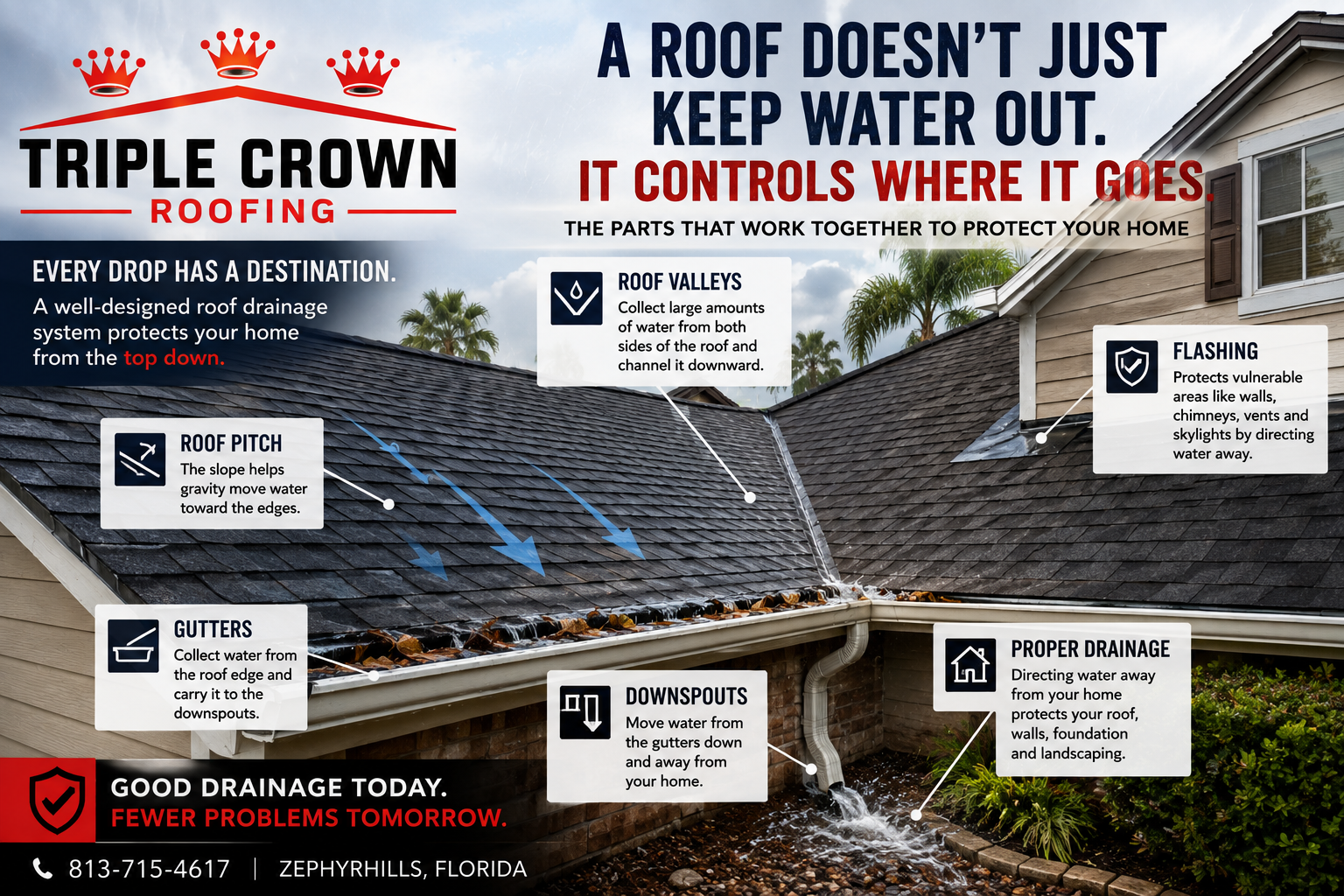
When everything is working properly, that water flows down roof slopes, through valleys, around penetrations and flashing, toward roof edges and gutters, and eventually safely away from the house.
But when just one part of that path isn't working correctly, water can begin traveling somewhere it was never supposed to go.
And that's when a drainage problem can become a roofing problem.
Think About How Much Water Your Roof Actually Handles
Imagine standing outside during one of those Florida downpours when it looks like someone turned on a giant faucet in the sky.
Every square foot of your roof is collecting rain.
A 2,000-square-foot roof receiving just one inch of rainfall can encounter well over 1,000 gallons of water. A larger or more complex roof may handle considerably more.
Now imagine several inches of rain falling during a series of thunderstorms.
That's thousands of gallons of water that your roofing system must successfully manage.
Fortunately, your roof was designed to do exactly that.
The problem begins when something interferes with the path that water is supposed to follow.
Roof Pitch: Gravity Is Your Roof's First Drainage Tool
One of the simplest parts of roof drainage is also one of the most important: gravity.
Your roof's pitch—or slope—helps determine how quickly rainwater moves toward the edge.
On a steeper roof, water generally moves off the surface relatively quickly.
Low-slope roofing systems require a different approach because water moves more slowly and has a greater opportunity to collect in low areas. That's one reason low-slope and flat roofing systems require specialized materials and installation methods.
But even pitched roofs can develop drainage problems.
Changes in roof geometry, additions, dormers, intersecting roof sections and other architectural features can create areas where enormous amounts of water converge.
One of the most important of those areas is the roof valley.
Roof Valleys: The Highways of Your Roofing System
Look at a roof with two slopes meeting inward and you'll usually find a valley.
These areas are essentially water highways.
Instead of handling only the rain that falls directly onto them, valleys collect water from large sections of the roof and channel it toward the bottom.
During a Florida thunderstorm, an incredible amount of water may be traveling through a relatively narrow valley.
That's why valleys deserve special attention.
Debris such as leaves, pine needles, twigs and roofing granules can accumulate in these areas and interfere with drainage.
Improper installation, deteriorating roofing materials or damage around a valley can also create opportunities for water intrusion.
A tiny problem in an area carrying a large volume of water can eventually become a very expensive problem.
Flashing: Small Pieces With an Enormous Job
Some of the most important components on your roof aren't very noticeable from the ground.
Flashing is installed around vulnerable transitions and penetrations to help direct water away from areas where it could otherwise enter the roofing system.
You may find flashing around:
- Chimneys
- Plumbing vents
- Skylights
- Walls that intersect with roof sections
- Roof valleys
- Certain roof edges and transitions
Flashing doesn't need to be dramatically damaged to cause trouble.
A small gap, lifted section, failed seal or improper installation can give water an opportunity to travel underneath roofing materials.
And water is remarkably good at finding small openings.
That's one reason the location of an interior ceiling stain doesn't always tell you exactly where the roof problem is located. Water may enter at one point and travel along decking, framing or other materials before finally becoming visible inside the house.
Gutters Are Part of the Roofing Conversation
Homeowners sometimes think of gutters as completely separate from their roof.
They're not.
Your roof collects and directs water toward its edges. Gutters then take over and move that water toward downspouts, which should discharge it safely away from the structure.
When gutters become clogged or overwhelmed, water can back up or overflow.
That water may affect fascia boards, soffits, siding and landscaping. In some situations, repeated water exposure near roof edges can contribute to deterioration that eventually affects the roofing system itself.
Even perfectly installed roofing materials can't perform their best indefinitely if water is repeatedly being forced into areas where it shouldn't be.
Florida Debris Can Quietly Change the Way Water Moves
Florida homeowners know how quickly outdoor surfaces collect debris.
Leaves.
Pine needles.
Spanish moss.
Small branches.
Seed pods.
Roofing granules.
And whatever else the afternoon thunderstorm decided belonged on your house that day.
Debris doesn't necessarily have to completely block drainage to cause trouble.
Sometimes it simply slows the water down.
When water slows down, it has more time to work its way beneath roofing materials, around flashing or into vulnerable transitions.
Organic debris can also retain moisture long after the rain stops.
That means a section of roofing may remain damp even while the rest of the roof is drying in the Florida sun.
Over time, those repeated wet-and-dry cycles can contribute to deterioration.
Why Repeated Florida Rain Changes the Equation
One thunderstorm is usually not the issue.
Florida roofs are built with rain in mind.
The bigger concern can be what happens when storms arrive day after day after day.
A roof gets soaked.
The storm passes.
Humidity remains high.
Another storm arrives.
Then another.
Areas that normally have plenty of time to dry may stay damp much longer.
Minor drainage problems become more important because the roofing system gets fewer opportunities to completely dry between storms.
That's why prolonged periods of repeated rainfall can reveal weaknesses that weren't obvious during drier weather.
Warning Signs Homeowners Can Look For From the Ground
You should never climb onto your roof simply to investigate a suspected drainage problem. Roofing surfaces can be slippery, steep and dangerous—especially after rain.
But there are several things homeowners may be able to observe safely from the ground.
Watch for:
- Water consistently pouring over the same section of gutter
- Gutters that appear to sag or pull away from the roofline
- Visible debris collecting in roof valleys
- Water staining around fascia or soffits
- Dark streaks or unusual discoloration near roof transitions
- Areas where water appears to concentrate during rainfall
- Downspouts discharging water directly against the house
- Interior ceiling or wall stains appearing after heavy rain
- Peeling paint or deteriorating wood near roof edges
- Persistent dampness around exterior walls
One of the best times to observe your roof's drainage system is actually while it's raining—without going outside into dangerous weather.
From a safe window, porch or covered location, you may be able to see where water is traveling and whether anything looks unusual.
A Roof Leak Isn't Always About a Bad Shingle
This is an important distinction.
When homeowners discover water inside their house, they often assume:
"My shingles are leaking."
Maybe.
But water intrusion can originate from numerous areas of the roofing system.
The problem could involve flashing.
A valley.
A roof penetration.
A transition between different roof sections.
A drainage issue.
A low-slope area.
Deteriorated sealant.
Damage around the roof edge.
That's why diagnosing a roof leak requires more than simply looking directly above the ceiling stain and replacing a few shingles.
The entire path of the water needs to be considered.
Good Roofing Is Really About Water Management
Roofing materials get most of the attention.
Homeowners talk about architectural shingles, metal roofing, tile, coatings and warranties.
Those things certainly matter.
But excellent roofing ultimately comes down to something much simpler:
Where will the water go?
A properly designed and installed roofing system anticipates that question everywhere on the roof.
When water hits this slope, where does it travel?
When two slopes meet, where does the water concentrate?
When water reaches this wall, how is it redirected?
When it encounters a vent, how does it get around it?
When it reaches the edge, where does it go next?
A roofing professional isn't simply installing materials.
They're building a system designed to control one of the most persistent forces your home will ever encounter.
Water.
Don't Wait for Water to Reach Your Ceiling
One of the most frustrating things about roofing problems is that homeowners often don't know something is wrong until water finally appears inside.
By then, the problem may have existed for quite some time.
Water intrusion can potentially affect roof decking, insulation, framing, ceilings and other materials before producing an obvious interior symptom.
Regular professional roof inspections can help identify drainage problems, deteriorating flashing, vulnerable roof transitions and other concerns before they become much larger repairs.
This can be especially valuable after periods of repeated heavy rainfall.
Triple Crown Roofing Understands Florida Roofs
At Triple Crown Roofing, we understand that protecting a Florida home requires more than simply putting roofing materials on top of it.
Your roof is a complete system.
Its slopes, valleys, flashing, penetrations, edges and drainage paths all need to work together to protect the structure underneath.
From our home in Zephyrhills, we proudly help homeowners throughout Central Florida understand the condition of their roofs and address roofing concerns before small problems have an opportunity to become expensive ones.
If something about your roof doesn't look right—or you've noticed unusual water movement, staining or signs of moisture—don't wait until the next Florida downpour puts it to the test.
Call Triple Crown Roofing at 813-715-4617 to have your roof professionally evaluated.
Because the real job of your roof isn't simply keeping rain out.
It's making sure thousands of gallons of Florida rain know exactly where to go.